Recently, the follwing image is posted in our share group. I will analyse what are the Pros. & Cons. in this image. What should we understand and to what extent we should follow this, I will point out.
I request all our “Share Group” members, follow our “info-stock-market” website and post your comments/ opinions on it. So that it will encourage me to post some more valuable posts.- Velmula Krishna Rao.
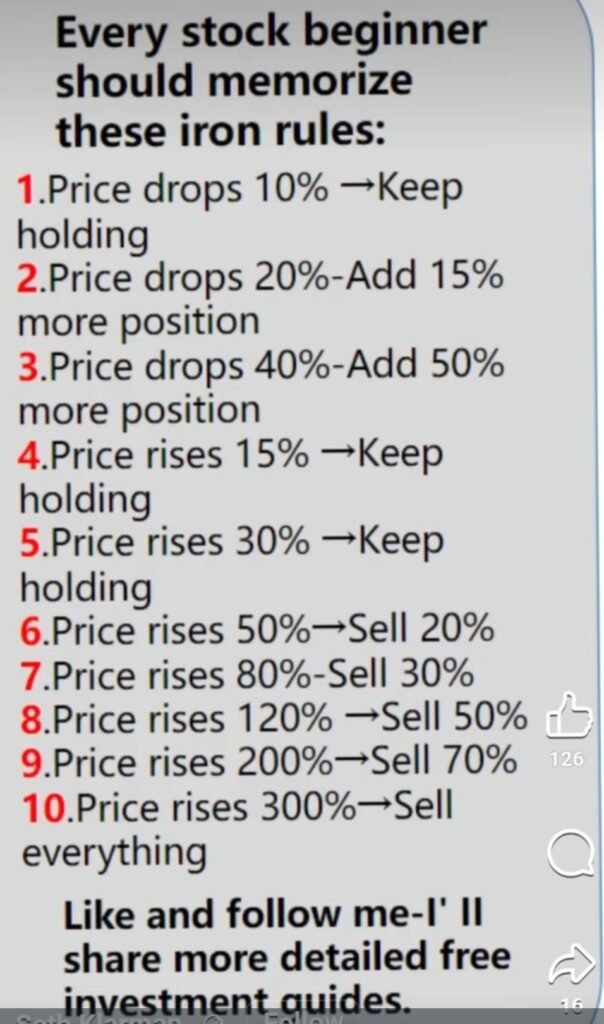
Let us think whether the above said policy/ method is correct ?
The method shown in the image is not a universally correct rule. It is only a simple averaging and profit-booking strategy shared for beginners. It may work in some situations, but it can also become dangerous if followed blindly.
Here is the practical reality:
What is GOOD in this method
1. Encourages discipline.
- Many beginners panic during falls and sell at bottom.
- This method teaches patience.
2.Partial profit booking is sensible:
- Selling some quantity after big rises (50%, 100%, etc.) is actually a good risk-management practice.
3. Useful for strong businesses:
- If applied only to fundamentally strong companies, averaging on dips can reduce average cost.
What is DANGEROUS in this method.
The biggest risk is this line:
“Price drops 40% → Add 50% more”
This is very risky because:
●Sometimes stocks fall 40% because the business itself is weak.
●Many stocks fall:
40% → then 70% → then 90%
●Averaging blindly can trap all capital.
Examples from Indian market history:
●Yes Bank. ●Vodafone Idea. ●Suzlon (old period) ●DHFL ●Reliance Power
People kept averaging and lost heavily.
Correct Way to Use Such Strategy
Suitable ONLY IF:
✅ Company fundamentals are strong. ✅ Debt is manageable. ✅ Sales/profit growth exists. ✅ Promoters are credible. ✅ Sector future is good. ✅ Fall is due to market panic, not fraud/business collapse
Then averaging may work.
Better Practical Version
During FALLS, Instead of fixed averaging:
| Fall | Action |
| -10% | Review reason |
| -20% | Add only if fundamentals strong |
| -30% – 40% | Add slowly in parts |
| Continuous fall | Stop averaging until stability |
Never average only because price fell.
This part is relatively reasonable:
During PROFITS.
| Profit | Action |
| +25% to +40% | Recover original capital partly |
| +60% to +100% | Book some profits |
| Multibagger | Hold core quantity if business strong |
Most Important Rule Missing in the Image
The image never discusses:
- Asset allocation
- Stop loss
- Fundamentals
- Debt
- Valuation
- Sector risk
- Position sizing
Without these, the strategy is incomplete.
For that of Situation :
- When you hold many stocks or
- If you want funds for re-investing/ re-investing,.
- Only a few stocks are performing strongly, then do not go for falling stocks.
Blindly averaging of falling stocks may not be suitable now. Preserving capital for your investment / re-investment may be more important than aggressive averaging.
A better approach for in such cases for any one may be:
👌Keep high-conviction quality stocks.
👌Exit weak/no-growth stocks gradually.
👌Avoid averaging in weak companies.
👌Use profits to strengthen your upcoming business.
Final Verdict
| Aspect | Verdict |
| Discipline | Good |
| Profit booking | Good |
| Blind averaging | Dangerous |
| Suitable for beginners blindly? | NO |
| Suitable with strong stock analysis? | Yes, Partly |
My Conclusion: So the method is partially correct but incomplete and risky if used mechanically.